Topics:
The International Linear Collider (ILC)
is proposed for the study of e+e- interactions at very high energies where the
production of multi-jet events with new heavy particles is dominant. Optimal energy and mass resolution
of all components of the final state will be achieved when the final state particles are reconstructed
with the highest possible spatial resolution.
Whereas all charged particles can be measured with sufficient precision in a large volume tracking
system, the neutral particles have to be reconstructed and identified in a calorimeter system
with a fine granularity.
The CALICE
collaboration studies the concepts and performance of such calorimeters within a long,
detailed R&D program for the scintillator electromagnetic calorimeter (ECAL)
and several options of high granular analog and digital hadronic calorimeters (HCAL) with
sensitive layers of gas or plastic scintillators. Our group is active in the SiW
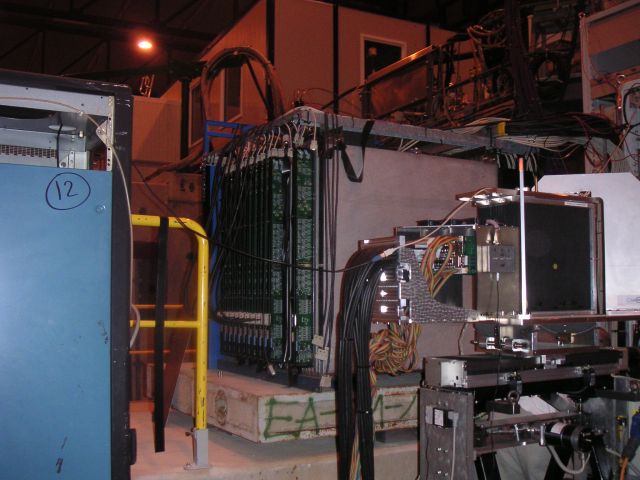
ECAL and tile hadron calorimeter TileHCAL. The first prototypes of calorimeters are shown
in the picture during the beam tests at CERN in 2006.
The TileHCAL subgroup has built first
a small prototype called MiniCal using SiPMs
or APDs as photodectors. Then it has built an analog 1 m³
steel/scintillator sandwich sampling calorimeter prototype
for study in various test beams. High granularity was achieved by 38 scintillator tile layers
(90 x 90 cm²) along a depth of 4.5 λ. The mosaic of detector layers exhibits
3 x 3 cm² tiles in the centre (100 tiles) surrounded by a large area covered with
6 x 6 cm² tiles and finally enclosed by strips of 12 x 12 cm² tiles.
MC studies showed that such a tile pattern allows excellent longitudinal and
lateral topological reconstruction of the cluster tree within the particle shower.
The ~ 8000 tiles in total are read out individually by wavelength-shifter fibres which illuminate
small photo-detectors SiPMs in tiles. The SiPM signals are
recorded in 16-bit ADCs.
In the test beam studies the TileHCAL is headed by an ECAL (~1 λ) and followed by a tail catcher
(~10 λ) to measure the shower leakage. The participating institutes are
our Institute, LAL Orsay, DESY and Hamburg University, JINR Dubna, ITEP,
MPI and MEPHI Moscow, Imperial College London and Northern Illinois University.
CALICE ECal is a novel type of electromagnetic calorimeter employing tungsten as a
radiator and square silicon diode pixels called pads as sensors. It is devised as
a tracking calorimeter, which can supply good position information about showers
because current designs of the calorimetry for the detectors at the ILC are in a
large part driven by the demands of jet energy resolution. Tungsten was chosen
because of it's physical properties like short radiation length and small Moliere
radius which make electromagnetic showers compact which in turn allows a very good
jet resolution. CALICE ECal is an R&D prototype. It is made of 30 sandwich layers
of alternating tungsten layers and PCBs. The mechanical structure is made of
tungsten wrapped in a carbon fiber. Almost each layer consists of 3 by 3 matrix
of silicon wafers, each wafer has 6 by 6 square Si pads. The very front end
electronics is located outside of the active area, mounted on a PCB. CALICE ECal
prototype has more than 9 000 active sensor elements in total. Signals from the
PCBs are read out via cables to the VME64 crate which provides digitization and
readout. The participating institutes are our Institute, Ecole Polytechnique,
LAL Orsay, LPC Clermont-Ferand, LPNHE Paris 6/7, DESY and Hamburg University,
MSU Moscow, Imperial College London, Okayama Univ.
The goal of the ongoing R&D work in ECAL and HCAL is to demonstrate
that particle flow measurements give the superior
jet and heavy particle mass resolution expected.
Our group specialises on calibration of the TileHCAL and
development and tests of Si sensors for the ECAL and analysis of data from
calorimeter beam tests. For the CERN beam tests in summer/autumn 2006 we
delivered the Calibration and Monitoring Boards (CMB). Its main purpose is to
produce short ~ 10 ns LED light pulse tunable in the light intensity to every
scintillator tile of HCAL. For the ECAL we made Si sensors of 1 cm²
sensitive area arranged in matrices 6 x 6 on Si wafers 500 microns thick.
Our activities are supported by the Institute of Physics
AS CR under the Institutional Research Plan Z10100502, by Ministry of Education
of the Czech Republic under the project LC527 and INGO-1P05LA259, by the
Commission of the European Communities, contract number RII3-026126 and by the
Grant Agency of the Czech Republic under the project 202/05/0653.
|